PortuguêsEnglishDeutsch
Edition 729
2012-05-17 > 2012-05-23
Tel.: 282 418 881
Password Forgotten?RegisterFree ClassifiedsArticlesWeekly FeatureReportInterviewNewsOpinionRestaurantsThe AlgarveDirectoryHelp
HomeArticlesReportDiscover the Via Algarviana (IV/IV)

Highlights & Low points

Discover the Via Algarviana (IV/IV)

There is no better way to lose weight than walking the Via Algarviana. Forget all the misleading advertising you get about weight loss – which simply makes us spend unnecessarily. Walking is the most natural, healthy, and certainly the cheapest, way to escape civilization’s ‘poisoned apple’, with all its temptations. The movement of one’s legs leads to the rediscovery of the slowest form of travel, predating even the invention of the wheel. With walking comes a rhythm – three, four or five kilometres an hour. And beyond this, the colour green contributes to a profound sense of well-being and rebalancing: green calms the mind, cures high blood pressure and steers body and soul back to serenity. Walking is one of the best therapies for bringing stressed-out moneymen, managers on the brink and hyperactive politicians back down to earth.
Uwe Heitkamp, Edition 575 (14 May 2009), No Comments »
Uwe Heitkamp

And whoever wants to walk the 340 kilometres of the Via Algarviana can do so all in one go. It takes between 13 and 14 days. Equally, one can complete the walk in stages, spreading the journey over weekends and Bank Holidays. Whoever decides to embark on this walk during their holidays, or who comes from abroad and doesn’t speak Portuguese, should find a guide with a talent for languages, or join a group - so that they don’t die of hunger by the end of the day, and so that they can ensure a roof over their head at night. For the interior Algarve has managed, thus far, to side-step the scourge of tourism: it has very few tarmac roads, and hotels and restaurants are scarce.

Diary: But the Via Algarviana also has its weak points. On the 11th day of the walk, I arrive at Bensafrim - a market town in the borough of Lagos, on a very busy main road. Here, whoever arrives from Nature will feel real stress for the first time. The straight track leads out onto a national road (full tarmac): unfortunately meeting buses, cars, trucks. Then, there’s the motorway, and rain. There’s not one tree to offer shelter – just asphalt and concrete in every direction. What can one do in a situation like this? The best way to stay dry is to go under the motorway bridge. And here, one waits for the rain to stop. Days previously, I had a similar experience in São Bartolomeu de Messines, in the borough of Silves. Same thing: I left Nature and entered our world of chaos: car engines and pollution. Messines and Bensafrim are the two weakest points of the Via Algarviana. Happily, they are the only exceptions…

Different regions, different customs. Getting to know the interior of the Algarve is a real challenge – and a controversy in itself, as tourism really only exists on the coast. And while the region is becoming dependent on tourism (largely because that’s all it dedicates itself to), it treats a lot of its visitors who arrive flush with money like cows that have been milked… just leaving them in the corner, forgotten. What most visitors seek in vain here is a good choice of hotels and restaurants with a good ‘quality-versus-price’ ratio, as well as friendly professional service. Is this because so many people have lost interest in working for salaries that average out at €700 a month? The coastline – Vilamoura, Albufeira, Armação de Pêra, Praia da Rocha, etc. - has been converted into kilometres of cement castles. The Via Algarviana could thus become a real alternative – in stark opposition to what’s offered by mass-tourism operators Thomas Cook, Neckermann, Tui, Olimar, Thomsons and First Choice. Walking holidays are a niche in the market for people who want to return to Nature, and avoid the concrete coastline like the plague. These people are also not prepared to pay astronomical prices for a bed and breakfast – way beyond the scale of wages paid in the region.

Diary: just as the motorway bridge in Bensafrim disappears from one’s line of vision, Nature returns. I walk through a forest of cork oaks that were harvested three years ago. Nature has transformed it into a magical forest: left and right, gnarled trunks grow at odd angles. I follow a track shaded by oak trees. I smell mushrooms and moss. The undergrowth is clear of bushes that could ignite like gunpowder; someone here is aware of fire prevention. Little cork trees grow among the mature examples of their species; hundred-year-old trees have between them younger plants budding from the oaks. These are rare forests in the Algarve. On the road to Barão de São João, I find one of the best guesthouses on the whole walk: Casa Monte Rosa.

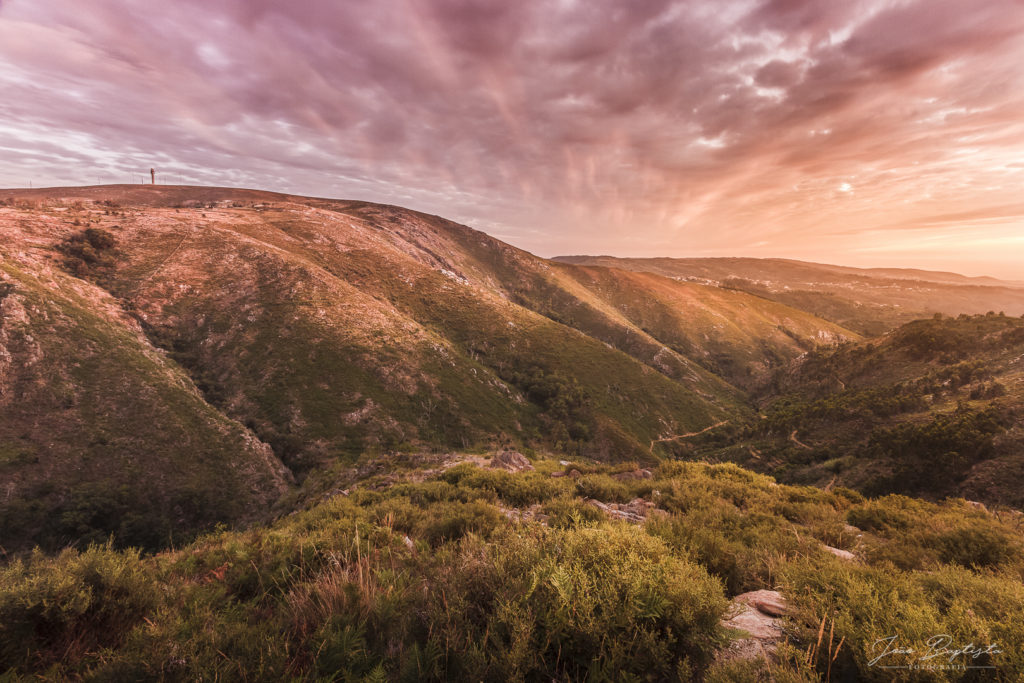
14 days of walking are coming to an end. Begun in Alcoutim, on the frontier with Spain, the first five days crossed the tranquil but wild eastern Algarve – the boroughs of Castro Marim, Tavira and Loulé. It’s permanently up and down. Another high point is the walk from Cachopo, via Alcaria Alta to Barranco do Velho over the Odeleite (stream). Later, the mountains of the Serra do Caldeirão transform into the rolling hills of Salir and Alte. Then, we arrive at the dams of the Funcho and Arade, in the borough of Silves. From here, we walk to the interior of the Monchique mountains. Up and up we go, to the very ceiling of the Algarve: the peaks of Picota and then Fóia (900 metres altitude). We come upon flocks of sheep and goats, untended cattle that eat where they roam, dogs that bark at us, circling eagles. Otters, foxes, wild boar and many other animals live here – as well as people who enjoy lives without rushing: without watches, deadlines, cell phones or cars. A world that shows the traditional way of life: agriculture and craftsmanship. The walk stops abruptly at Cape St Vincent. The waves of the Atlantic crash into steep cliffs, rising up high. Kilometres and kilometres of empty beaches in springtime stretch below. Here, where Portugal’s most powerful lighthouse stands, the old world ends. The walk is the goal!

Related Articles
Kit and equipment ‘musts’
Uwe Heitkamp, Edition 574 ( 7 May 2009), No Comments »
Where to stay the night – what to eat?
Uwe Heitkamp, Edition 573 (30 Apr 2009), No Comments »
Where to begin?
Uwe Heitkamp, Edition 572 (23 Apr 2009), No Comments »
Comments
Login or register so that you can make a comment.No comments. Be the first to make a comment.