PortuguêsEnglishDeutsch
Edition 729
2012-05-17 > 2012-05-23
Tel.: 282 418 881
Password Forgotten?RegisterFree ClassifiedsArticlesWeekly FeatureReportInterviewNewsOpinionRestaurantsThe AlgarveDirectoryHelp
HomeArticlesReportDiscover the Via Algarviana (I/IV)

Where to begin?

Discover the Via Algarviana (I/IV)

Whoever goes on a journey has a lot to talk about. But, where to begin? Crossing the Algarve on foot, from the northeast to the southwest in 13 days, is an absolutely exceptional trip. Against the forces of the elements. A few days before we began our trip, a group of 24 walkers from the «Almargem» environmental association, 44 people on bicycles, and another ten on horseback, set out to conquer the Via Algarviana – the walk that begins in Alcoutim and ends at Cape St Vincent. Our little group of three – Laila, Sara and Uwe – took advantage of the Easter holidays to walk the 340 kilometres together. For the writer of this story, this was the second such walk since 2008.
Uwe Heitkamp, Edition 572 (23 Apr 2009), No Comments »
Uwe Heitkamp
Hugo Stumpf e Sara Pittalis

Some of the time it was easy. In a few critical situations – where there were no signposts – we followed the tracks of horse poop. On the tenth day of walking, south of Marmelete, in the borough of Monchique, the poop led us to the desert of a eucalyptus “forest” – something that should never be called a forest. Here, the owners of the land have started to pull all the old eucalyptus trees out by their roots – so decimating the root cause of forest fires. But, just north of Mealha, I found kilometre after kilometre of new eucalyptus plantations.

People have poor memories. In August 2003, a fire that began in Cascais and was fed by a “forest”of eucalyptus, spread rapidly to Marmelete and Aljezur. In the space of a few hours, the flames reached gigantic proportions – covering more than 30 kilometres from Aljezur to Odemira. Hundreds of homes were burnt. But, in spite of this, Marmelete still to this day only posesses one fire truck – while there are innumerable new “forests”, all of them full of young eucalyptus. Meanwhile, in the middle of our path, I notice a load of cut trees. Right and left, I see metres and metres of trunks piled up. The boxes which carried around 8.000 new eucalyptus have just been left, discarded, in the middle of the track – along with the orange plastic sacks that contained chemical fertilizer. It looks more like a rubbish dump. The rain begins. I put on my rain jacket and continue walking. In Monchique, the authorities rule against Nature.

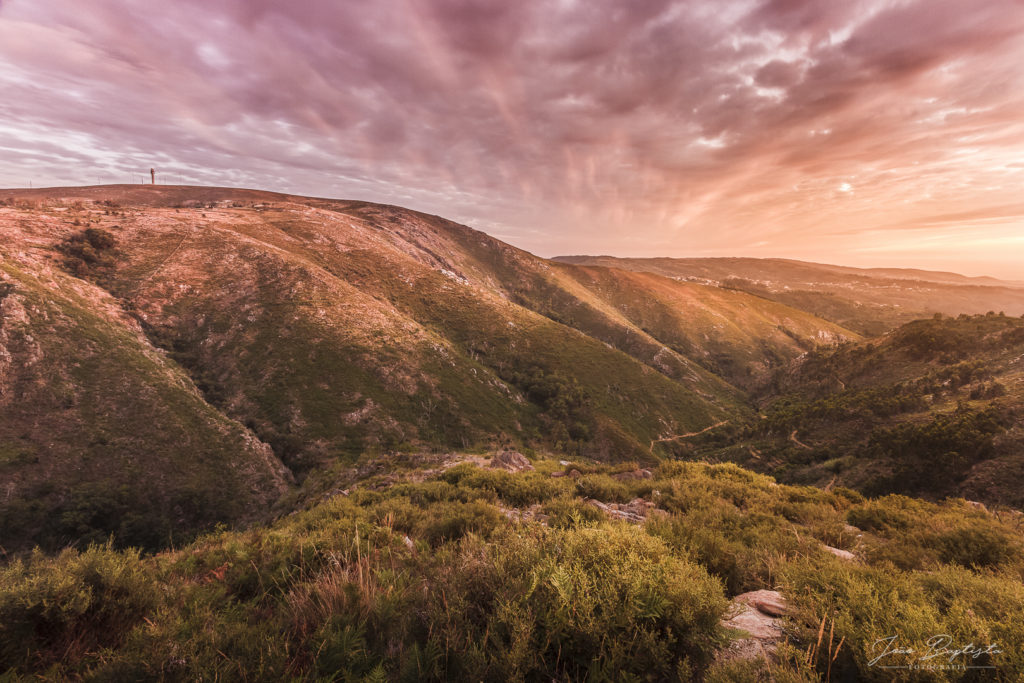
Whoever wants to discover the real Algarve, or better still, get a real picture of the state of our region, should invest a fortnight of their lives walking the ancient pilgrimage route from Alcoutim to Cape St Vincent. In the borough of Loulé, between Salir and Alte, the walker comes across a collection of ancient cork oaks, olive trees and hundred year old carobs. It’s a wonderful sight – a kind of guard of honour that touches us all deeply on Easter Saturday. Here we meet Hugo Stumpf, a pioneer of tourism in the Algarve. Despite his 70 years of age, this gentleman easily walked the 17 kilometres between Salir and Alte with us.

Stumpf is one of a small group of nature lovers who knows the pilgrimage routes of Santiago de Compostela just as much as those of the Via Algarviana. Spring is a perfect time to get to know the sea of wild herbs and flowers: yellow broom, lavender with its blue petals, pink lilies, the green of the mint, thyme, rosemary and wild orchids. This is an incredible holiday for one’s eyes and nose! The Via Algarviana exudes an unparalleled aroma: Nature’s perfume, strong yet subtle, sweet yet sour, wild and gentle, follows us day and night.

The Via Algarviana also provides us with melodies for the soul, and ears: the nightingale sings us to sleep. In the morning, the cuckoo flies from tree to tree, accompanying us. Larks and hoopoes are always there to meet us with their songs. April and May are generally the best months of the year to discover the real Algarve. It’s a time that the industrious swallows – specialists in making nests of clay – appear and make their homes: vertical as well as horizontal, underneath the roof tiles of houses.

On the second day or our walk, in the middle of a morning full of sun, we were still in the north east of the Algarve, and crossed the Ribeira de Foupana (stream) in Palmeira – the border between the boroughs of Castro Marim and Alcoutim. We put our knapsacks to one side, took off our trousers and bathed in the refreshing crystal clear waters. Later, we arrived at the little village of Furnazinhas. The “Casa do Lavrador” offers walkers a bed for the night. Here, where the few inhabitants still farm the land the old-fashioned way, there is no little mini-market, let alone a shopping mall or restaurant. In Furnazinhas the inhabitants live principally from the animals they rear themselves: goats, sheep, pigs, chickens – and from what they cultivate: potatoes, beans, corn, carrots, tomatoes, peppers, garlic. We found an elderly population. Rural desertification is a current theme: the majority of young people want to live in towns. Forget the old-fashioned, natural, healthy forms of eating: milk doesn’t come from cows – you find it on the shelves of supermarkets. Just like you find electricity in an electrical socket!

Learn more about our trek along the Via Algarviana next week.

Via Algarviana II/IV – Where to stay the night – what to eat?

Via Algarviana III/IV – Kit and equipment ‘musts’

Via Algarviana IV/IV – Highs and lows.

Related Articles
Highlights & Low points
Uwe Heitkamp, Edition 575 (14 May 2009), No Comments »
Kit and equipment ‘musts’
Uwe Heitkamp, Edition 574 ( 7 May 2009), No Comments »
Where to stay the night – what to eat?
Uwe Heitkamp, Edition 573 (30 Apr 2009), No Comments »
Comments
Login or register so that you can make a comment.No comments. Be the first to make a comment.